If you have spent any time on SEO you have probably run into this situation. A website has expertise, genuine reviews, qualified authors and a solid reputation. It still struggles to rank the way you would expect. That gap usually comes down to one thing.
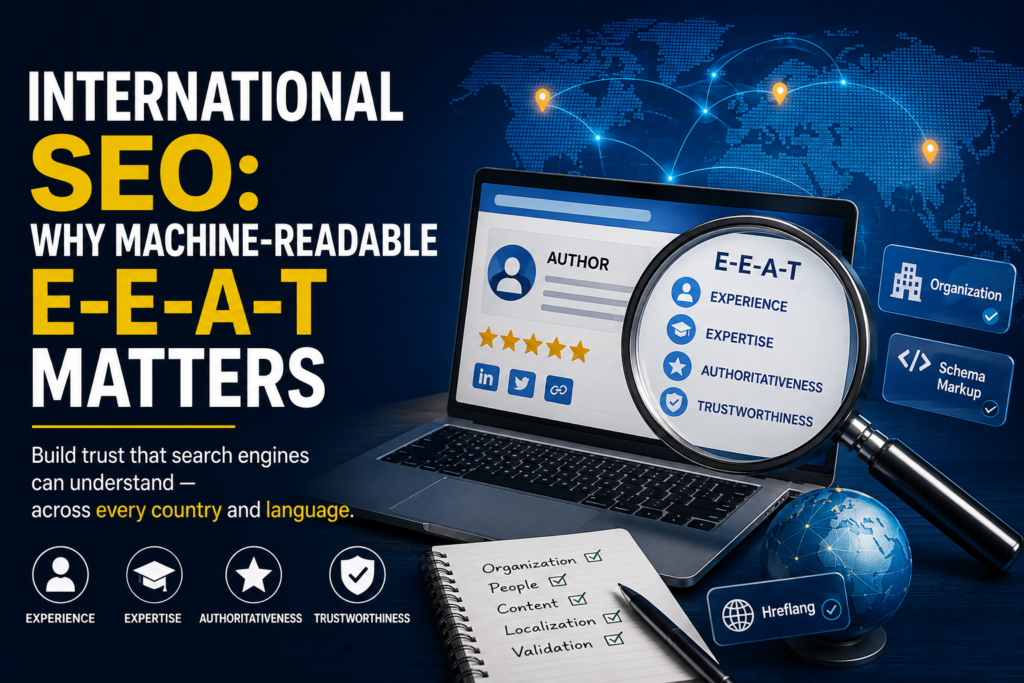
International SEO: why machine-readable E-E-A-T matters is a question asked early because trust that a human visitor can feel isn’t always trust that a search engine can read.
Over years of auditing country websites I have found that the biggest ranking blockers aren’t usually about content quality. They are about whether that quality’s communicated in a way search engines can actually parse.
What “Machine-Readable E-E-A-T” Actually Means :-

Google’s E-E-A-T framework—Experience, Expertise, Authoritativeness and Trustworthiness—is fundamentally about credibility. Credibility that only lives in prose, design and reputation is invisible to a crawler unless it is connected through signals: schema markup, author bios linked to profiles consistent business information and clear entity relationships.
The biggest tip-off that a site’s E-E-A-T isn’t machine-readable is simple: the trust exists. It isn’t clearly represented in information. A company might have experienced authors, strong reviews, certifications and a detailed About page. If none of that is tied together with Organization schema Person schema sameAs profile links and NAP (name, address, phone) data, search engines have a time connecting the dots.
In SEO this problem multiplies. I regularly see author names, credentials or organization details that are accurate on the English-language version of a site but change shrink or disappear entirely on the French, German or Japanese version. That inconsistency is a flag not for search engines but for anyone trying to verify whos actually behind the content.
A Real Example: Closing the Machine Gap
One case that illustrates this well involved a service website with content and real industry experience. On the surface everything looked credible. But during the audit a few gaps became clear:
- Authors weren’t connected to verified profiles.
- Organization information was inconsistent across the sites country versions.
- There was structured data linking the content the authors and the business itself.
The fix wasn’t glamorous, It was thorough:
- Implementing Organization, Person and Article structured data.
- Making author credentials and expertise clearly visible on the page not just implied.
- Connecting verified profiles through markup.
- Standardizing company information across every version of the site.
- Correcting hreflang implementation so search engines understood which version served which audience.
After these changes the right approach is to monitor impressions, rankings, branded search volume and organic traffic over time. Do not expect a spike. Structured data doesn’t create rankings by itself. What it does is make genuine expertise, experience, authority and trust easier for search engines to understand and correctly associate with the entities and content.
The Most Common Mistake: Translating E–A-T Instead of Localizing It
The single most common mistake I see when companies try to scale E-E-A-T internationally is treating it like something you can simply translate.
A business might have a site with author credentials, business details and reviews. Then it launches translated versions. Stops there. The author’s name gets translated. Their credentials, local references and relevant sources don’t get properly localized. Organization details often go inconsistent between country versions too.
The better approach is to separate two things that get conflated:
- The foundation, which should stay globally consistent. Your core organization entity, your author entities, your verified credentials.
- The evidence, which needs to be locally relevant. Content, region-specific sources market-appropriate credentials and business information that actually applies to that audience.
In short: E-E-A-T should be globally consistent in its foundation. Locally relevant in how that trust gets demonstrated.
A Practical Framework for Auditing Machine- E-E-A-T
As a freelance digital marketer in Palakkad when auditing a site’s machine-readable E-E-A-T signals I follow five steps:
- Organization
Check for a name, address and contact information, a logo, Organization schema and official profiles that are correctly linked.
- People
Look for author pages, visible credentials and experience linked to profiles and Person schema where appropriate. The connection between the author and the content they wrote needs to be explicit not assumed.
- Content
Look for first-hand experience, credible sourcing information and clear editorial responsibility. Confirm that Article or other relevant structured data actually matches what’s on the page.
- Localization
For sites review hreflang implementation, language and country. Whether organization and author information stays consistent across every version of the site.
- Validation
Use tools like Google’s Rich Results Test and the Schema Markup Validator to catch errors missing properties or misleading markup before it causes problems.
The guiding principle behind all five steps: structured data should accurately describe real-world information that’s already backed up by content. Adding schema just to try to influence rankings without the substance behind it isn’t a shortcut. It’s a risk.
Why This Matters More Than Ever
There’s an assumption that E-E-A-T’s basically a schema-markup exercise. Add the data connect a social profiles mark up your authors and you’re done. That’s not accurate. Machine-readable signals help search engines understand credibility. They can’t manufacture credibility that’s not there in the place.
This matters in SEO because it’s tempting to translate the content and trust signals into ten languages and expect ten markets to respond the same way. They won’t. Real expertise and relevance have to be demonstrated in each market even while the core organization and author information stays consistent behind the scenes.
The order of operations matters: build expertise first make that expertise visible to your users. Then focus on making the relationships between your people, your organization and your content understandable to machines. Skipping straight to the schema without the substance is building on a foundation that’s not there.
FAQs
Does adding schema markup guarantee rankings?
No. Structured data helps search engines understand and connect existing credibility signals. It doesn’t create rankings or credibility on its own.
Is it enough to translate my author bios and business information for markets?
Not on its own. Translation covers language. Localization means adapting credentials, sources and business details so they’re actually relevant and verifiable in that market.
What’s the first thing to check in an E-E-A-T audit?
Start with the organization entity. Confirm your name, address, contact details, logo and Organization schema are consistent and correctly linked across every country and language version.
Key Takeaways
- Trust that’s visible to humans isn’t automatically visible to search engines. It needs to be structured.
- Inconsistent author or organization details across country versions are a flag.
- Localize the evidence of expertise per market; keep the foundation (organization and author entities) consistent.
- Use an audit framework: organization, people, content, localization and validation.
- Structured data should reflect substance. It’s a tool for clarity not a shortcut, to rankings.
International SEO: Why Machine-Readable E-E-A-T Matters in 2026International SEO: Why Machine-Readable E-E-A-T Matters in 2026International SEO: Why Machine-Readable E-E-A-T Matters in 2026International SEO: Why Machine-Readable E-E-A-T Matters in 2026International SEO: Why Machine-Readable E-E-A-T Matters in 2026International SEO: Why Machine-Readable E-E-A-T Matters in 2026International SEO: Why Machine-Readable E-E-A-T Matters in 2026International SEO: Why Machine-Readable E-E-A-T Matters in 2026International SEO: Why Machine-Readable E-E-A-T Matters in 2026International SEO: Why Machine-Readable E-E-A-T Matters in 2026International SEO: Why Machine-Readable E-E-A-T Matters in 2026