Digital Marketing Career With No Experience: How to Start in 2026
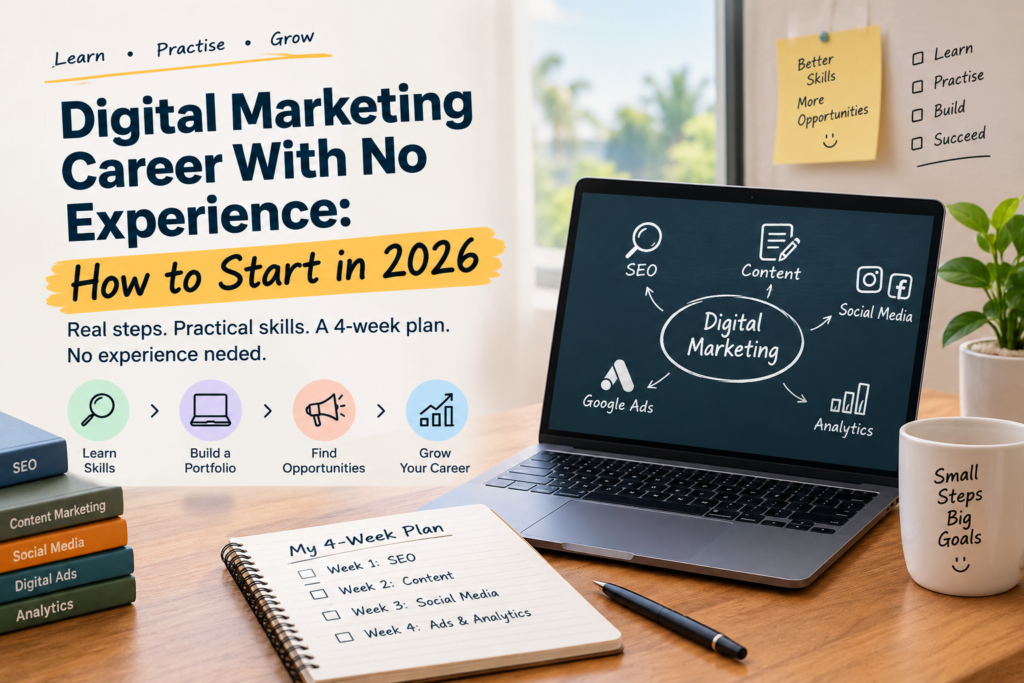
Starting a digital marketing career with no experience can feel like a trap. Jobs ask for experience, and you can’t get experience without a job.
I know that feeling. I’m a freelance digital marketer in Palakkad, Kerala. After studying English Literature and Library and Information Science, I became interested in digital marketing. Financial limitations meant I couldn’t train right away, so I put the idea aside. Later, I trained at DOTIN Digital Marketing Academy in Kochi.
The course was only the start. The harder part was turning what I learned into real work when I had no clients, no portfolio, and no testimonials.
I don’t have a client success story to sell you. This guide covers what I’ve actually tried, what went wrong, and the practical steps I’d follow if I were starting again.
Is Digital Marketing a Good Career in 2026?
It can be, but it isn’t a shortcut to a job or a high income.
The American Marketing Association’s 2026 careers report describes marketing jobs as shifting rather than disappearing, with execution-focused roles declining while senior and strategic roles hold steady. It also says AI fluency is becoming a baseline expectation, not a bonus. The same report notes that SEO specialist postings fell by 15% in one analysis it cites.
That sounds discouraging, but it points to a clear lesson. Routine tasks are the easiest to automate. Research, judgement, and the ability to explain your decisions are harder to replace.
The honest downsides:
-
- Your first job or client can take a long time to land.
-
- Platforms and tools change constantly, so you never stop learning.
-
- SEO results are slow, and ads can burn budget without producing enquiries.
-
- Freelancing needs sales and communication skills, not just marketing skills.
I’d recommend this field to people who enjoy research, writing, and problem-solving. I’d be cautious about recommending it to anyone expecting quick money or a guaranteed job after a course.
Which Digital Marketing Skills Should Beginners Learn First?
Don’t try to learn everything at once. This is the order I’d follow:
| Order | Skill | Why start here |
|---|---|---|
| 1 | SEO and keyword research | Teaches you how people search and what they want |
| 2 | Content writing and research | Useful in every channel, from blogs to ad copy |
| 3 | Social media marketing | Shows how content supports a business goal |
| 4 | Google Ads | Plan campaigns before spending real money |
| 5 | Analytics and reporting | Shows whether your work actually helped |
Start with SEO because it teaches search intent, which is the idea behind almost everything else. Google’s own SEO Starter Guide is a good place to begin. It explains how to make it easier for search engines to crawl, index, and understand your content.
The AMA also advises early-career marketers to build real depth in two or three areas rather than betting on one narrow specialty. Pick a main skill, but keep the basics of the others.
Free tools to start with
You don’t need paid subscriptions. Begin with these four:
-
- Google Keyword Planner for keyword research
-
- Google Search Console to see how a site performs in search
-
- Canva for social media designs
-
- Google Sheets to track keywords, plans, and results
Add Google Analytics 4, Meta Business Suite, and Google Ads once you’re comfortable.
Do You Need a Paid Course?
No, but structure helps.
My training at DOTIN gave me a clear order to learn things in, which saved time. But finishing a course is not the same as becoming a digital marketer. The real learning started when I applied the lessons.
If you’re unsure, start with free resources and one small project. Pay for a course only if it fills a real gap. When you compare courses, look for:
-
- Practical assignments, not just videos
-
- Feedback from trainers
-
- Current tools and updated lessons
-
- Realistic projects
Be careful with any course that promises guaranteed jobs or instant rankings.
How to Build a Digital Marketing Career With No Experience: A 4-Week Plan
You don’t need a paying client to start practising. Choose one local business type, such as a bakery, dental clinic, or tuition centre, and use it for all four weeks. Treat it as a sample project.
Week 1: SEO. Research 10 keywords and note the search intent behind each. Write a title tag, meta description, and heading structure for one service page.
Week 2: Content. Write one useful article of 700–1,000 words that answers real customer questions. Edit out repetition and unsupported claims.
Week 3: Social media. Define one audience and one goal. Build a seven-day content calendar and design three sample posts in Canva.
Week 4: Ads and analytics. Draft three Google Search ads without publishing them. Outline a campaign structure and budget, then explain how you’d measure success.
After four weeks, you won’t be an expert. You will have three pieces of work you can show and explain.
How to Build a Portfolio When You Have No Clients
Be honest about what each piece is. I’d sort all work into three labels:
| Label | What it means |
|---|---|
| Personal project | Work on your own website or blog |
| Concept project | A sample strategy for an imagined business |
| Client project | Real work, shared with the client’s permission |
If you have no client work yet, leave that section out. Never invent testimonials, traffic growth, or revenue figures. For each project, show the objective, your research, your approach, what you actually did, any real data with dates, and what you’d improve next.
What I’ve Learned From Practising on My Own Website
I used my own website, bibinchandru.com, as my first real project. Here is what I’ve done and learned, including what hasn’t worked yet.
I made a keyword mistake. At first, I thought repeating my target keyword would help me rank. It doesn’t. Search intent, useful content, and clear page structure matter more. Keywords should guide your writing, not control it.
I learned to read real data. In an earlier Search Console snapshot, my site showed 1 impression, 0 clicks, and an average position of about 279. That is not a success story. It was a baseline, and it taught me that appearing in search results and getting visitors are different things.
Google didn’t pick the page I expected. I built a separate social media marketing service page, but my homepage appeared for a related search instead. That showed me the need for clearer page topics, internal links, and metadata.
Backlinks aren’t automatic. I created profiles and posts on platforms like Medium, Pinterest, and Linktree. Some links never appeared in Search Console. Creating a link, getting it indexed, and having Google count it are three different things.
I haven’t yet turned this work into consistent client enquiries, and I won’t pretend otherwise. What I can say is that I’ve moved from learning concepts to applying them and measuring the results honestly.
Common Mistakes Beginners Make
-
- Waiting for clients before practising. Start with your own site or a sample project.
-
- Collecting certificates instead of building proof. Work samples show more than badges.
-
- Overstating results. Label sample work clearly and report only data you’ve measured.
-
- Chasing every tool. Learn the tools that fit your current project.
-
- Relying on AI without judgement. Use it to draft and research, but check facts and fit.
How to Find Your First Opportunity
Learning marketing and finding clients are two separate skills. Waiting for people to find you on Google isn’t enough. A more direct approach works better:
-
- List local businesses whose websites or online profiles could be improved.
-
- Review their public pages and spot one or two specific fixes.
-
- Send a personal message explaining those fixes, not a generic pitch.
-
- Show your portfolio, then follow up politely.
-
- Track outreach, replies, and conversations in a spreadsheet.
Aim to start real conversations rather than send hundreds of identical messages.
FAQs
Can I get a digital marketing career with no experience?
Yes, but you’ll need to show practical skills. A small portfolio of clearly labelled projects helps more than a certificate alone.
How long does it take to become a digital marketer?
You can learn the basics in a few months, but skill grows with practice. A four-week plan builds a foundation, not mastery.
Do I need a degree for a digital marketing career with no experience?
Not necessarily. My background is in English Literature and Library and Information Science, and those research and writing skills helped. What employers and clients see is your ability to do the work.
Is digital marketing still worth learning with AI?
Yes. AI changes how the work is done, so learn the fundamentals first, then use AI to support your judgement instead of replacing it.
Conclusion: Start Small and Keep Going
A digital marketing career with no experience starts the same way for everyone: with one small, honest project. You don’t need perfect conditions, a big budget, or a client to begin.
Learn the fundamentals, practise weekly, and document your work. Label sample projects clearly and measure real results. Then approach local businesses with specific ideas.
You may be starting without experience, but that doesn’t mean you’ll stay inexperienced. Take the next practical step this week.