How to Make Your Business Appear in ChatGPT, Gemini and Google AI Search in 2026
How to Make Your Business Appear in ChatGPT, Gemini and Google AI Search in 2026?
If you’ve searched for how to make your business appear in ChatGPT, Gemini, and Google AI Search, you’ve probably noticed the advice out there sounds like recycled SEO tips with “AI” stapled on top. After working directly with small businesses on this exact problem, I can tell you that chasing a secret “GEO hack” is the wrong starting point. No public formula guarantees placement, and OpenAI itself says ChatGPT Search uses multiple factors to decide what’s relevant and reliable—not a single trick you can install.
What really works feels like the way of building trust, but with a new view of how AI search optimization reads the internet. This guide shows what truly changes everything. It gives a real before‑and‑after story, lists the mistakes I would warn you about, and offers a plan you can practice for about one hour each week.
Why AI Search Optimization Is Different From Traditional SEO ?
How to Make Your Business Appear in ChatGPT, Gemini and Google AI Search in 2026
generative Engine optimization and traditional SEO overlaps with more than most writers say. Geo and traditional SEO are not the same. Traditional SEO rewards pages that match a keyword exactly. AI search optimization tools such as ChatGPT Search, Gemini, and Google’s AI Overviews do more.
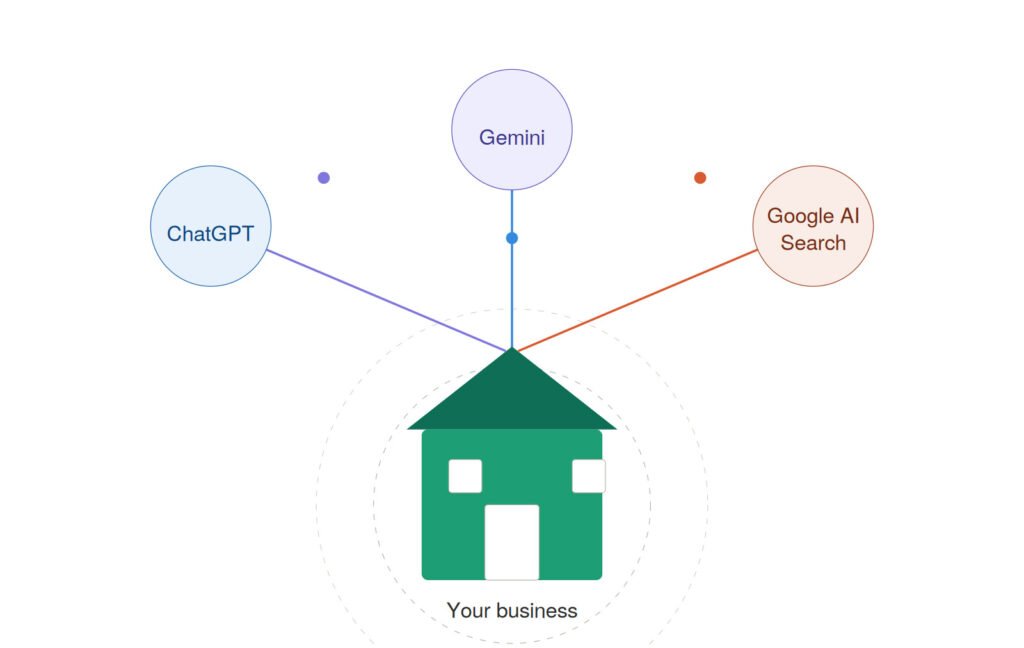
They must understand who a business really is, decide if the business matters to a question, and gather proof from many sources before saying anything.
This is a change. Instead of asking “which page ranks for this keyword,” the more useful question becomes: if an AI system had to explain what your business does and why it should recommend you, does the web contain enough consistent evidence to support that?
A Real Example: Building AI Visibility From the Ground Up
How to Make Your Business Appear in ChatGPT, Gemini and Google AI Search in 2026
Take a typical local-service business: it had a website, a Google Business Profile, and a few social accounts, but the information was inconsistent, the service pages were thin, and almost no independent websites mentioned it. Instead of starting with keywords and backlinks, the work started with one question — does the web contain enough consistent evidence for an AI system to explain what this business does and why it should be recommended?
From there, the process looked like this:
⦁ Made the core business information — name, services, location, contact details — consistent across the website and every business profile.
⦁ Rebuilt a generic “Services” page into detailed pages explaining what’s done, who it’s for, the process involved, and the qualifications behind it.
⦁ Strengthened the About page with real people, real experience, and documented certifications instead of vague “industry leader” claims.
⦁ Replaced generic articles with first-hand content — what was actually tested, what worked, what didn’t, and what was learned.
⦁ Built a credible external footprint through legitimate directories, publications, professional profiles, and genuine reviews — not mass low-quality links.
⦁ Fixed technical fundamentals: crawlability, indexability, internal linking, and structured data where it made sense.
Only after those foundations were in place did the real measurement start — testing genuine customer questions and tracking whether the business appeared, and which sources the AI cited.
The honest way to describe the result isn’t “we added GEO keywords, and ChatGPT started recommending us.” It’s this: before, the business’s identity, expertise, and authority were fragmented across the web. After, it had a clearer entity, stronger first-hand evidence, more useful content, and consistent information everywhere — which is the actual foundation AI systems need before they can confidently recommend anyone.
The Biggest Mistakes Businesses Make When Chasing AI Visibility
How to Make Your Business Appear in ChatGPT, Gemini and Google AI Search in 2026
The most common mistake is treating AI search like a new keyword-ranking game — stuffing phrases like “best business for ChatGPT” or “recommended by AI” onto a website. That solves the wrong problem, because AI systems assess relevance and credibility, not exact wording. A restaurant chasing “best family restaurants in my area” won’t get far with an article titled “Why We Are the Best Family Restaurant Recommended by AI.”
It gets much further by clearly explaining its cuisine and location, keeping business information accurate, earning genuine reviews, and publishing real, experience-based content.
Beyond that, watch out for:
1. Mass-producing generic AI-written content. Fifty articles that repeat what already exists on hundreds of other sites don’t build distinctiveness. Five original, experience-based articles are worth more.
2. Ignoring traditional SEO fundamentals. Crawling, indexing, internal linking, authoritative references, and page experience still matter — Google’s own documentation says its AI search experiences still rely on established Search fundamentals.
3. Manufacturing authority. Fake case studies, fake reviews, fabricated statistics, or claiming an AI system recommended you when it didn’t. If you don’t have a particular result yet, say so — that honesty is worth more long-term than any shortcut.
How to Make Your Business Appear in ChatGPT, Gemini and Google AI Search in 2026
A Practical Weekly Framework to Improve AI Search Visibility
You don’t need a full-time GEO strategy to get started. If you have about one hour a week, this five-step cycle builds real, compounding authority instead of chasing a moving target:
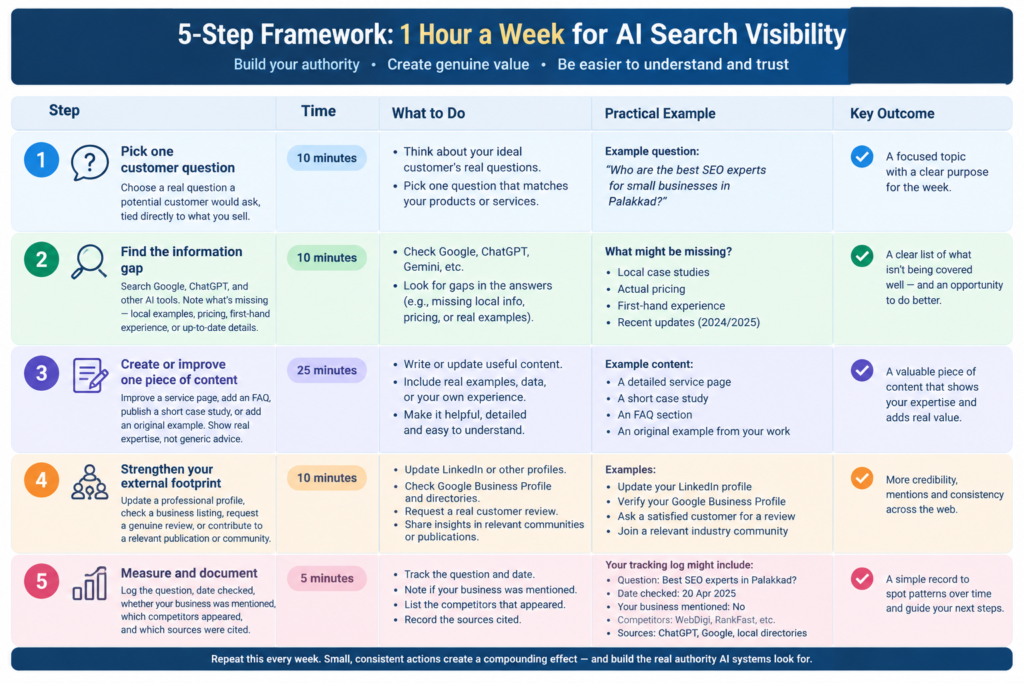
Repeat this every week and expect patterns over months, not dramatic weekly swings. Track whether your business is appearing for more relevant questions, whether AI systems describe it correctly, and whether competitors still dominate particular topics. That log tells you exactly what to work on next.
What I Got Wrong About AI Search (Lessons Worth Sharing) ?
How to Make Your Business Appear in ChatGPT, Gemini and Google AI Search in 2026
Early on, it was tempting to assume AI search would just be “SEO with a new interface” — that the same keyword-and-backlink formula would transfer directly to ChatGPT and Gemini. It doesn’t fully hold up, because AI-generated answers add a layer of understanding of entities, context, and relationships that traditional ranking factors don’t fully capture.
It’s also easy to assume there’s a specific GEO trick waiting to be discovered. There isn’t a documented formula that guarantees a recommendation, and platforms change how they retrieve and synthesize information over time. More content isn’t automatically better either — a large library of generic articles can still leave a business with a weak digital presence if nothing in it is distinctive.
The bigger shift has been in how I think about measurement. One mention in one AI answer after a change doesn’t prove causation — AI answers shift based on question wording, context, location, and freshness. The more reliable approach is testing a set of realistic customer questions over time rather than celebrating a single result.
If I had to summarize the whole lesson in one line, it’s this: I started out thinking AI search rewards optimization tricks. It actually rewards businesses that have something real to say and enough credible evidence online to back it up. That’s the shift from “how do I optimize for the AI” to “how do I become a more credible source of information” — and it’s a far more durable way to work.
FAQs
No. OpenAI and Google both say that their AI search features rely on factors to pick answers that are relevant and trustworthy. Neither company promises placement for any business. The best long-term strategy is to focus on building authority and making your content easy to find, not looking for a magic formula.
No. Quite the opposite. Things like being crawlable, having a clean site structure, creating high-quality content, and using sources are still very important. AI search does not replace these basics. It just adds another layer on top of what you do in SEO.
It depends. There’s no time frame. Since AI systems pull together information from lots of places, changes usually show up slowly over several months. You’re unlikely to see a boost after one update. It’s about steady progress over time.
Making sure your core business information — name, services, location, and expertise — is accurate and consistent everywhere it appears online, and that AI crawlers can actually access your site.
Key Takeaways
How to Make Your Business Appear in ChatGPT, Gemini and Google AI Search in 2026
⦁ There’s no reliable “GEO hack” — AI search rewards businesses that are easy to understand, easy to verify, and backed by credible evidence across the web.
⦁ A clear identity, first-hand experience, and consistency across your website and third-party sources matter more than keyword placement alone.
⦁ Avoid manufacturing authority: real results, documented honestly, outperform fabricated case studies or reviews every time.
⦁ A simple one-hour weekly habit — pick a question, close the gap, publish something genuine, strengthen your footprint, and measure — builds compounding visibility over time.
If you take one thing from this: stop trying to optimize for the AI, and start becoming a source it has good reason to trust.
Want your business to appear in ChatGPT, Gemini, and Google AI Search?
Ready to Grow Your Business Online?
Discover how to make your business more visible in ChatGPT, Gemini, and Google AI Search with practical AI SEO, local SEO, and online authority strategies for 2026.